After 2 years of war in Gaza, universities begin to reopen, offering hope
Written by ABC Audio ALL RIGHTS RESERVED on December 10, 2025
(GAZA STRIP) — After two consecutive years of war that upended nearly every aspect of life in the Gaza Strip, universities are slowly beginning to reopen, restoring a path to education despite extraordinary levels of destruction.
Before Oct. 7, 2023, Gaza had 17 higher-education institutions, comprising hundreds of buildings. Today, most of these facilities are in ruins, according to the Palestinian Ministry of Education and Higher Education.
More than 100 university buildings were destroyed during the war, while roughly 200 university employees were killed, the education ministry said. The devastation has raised doubts about whether higher education could resume at all. But at Al-Azhar University in Gaza, the administration and some students told ABC News they are determined not to let the war erase an entire generation’s future.
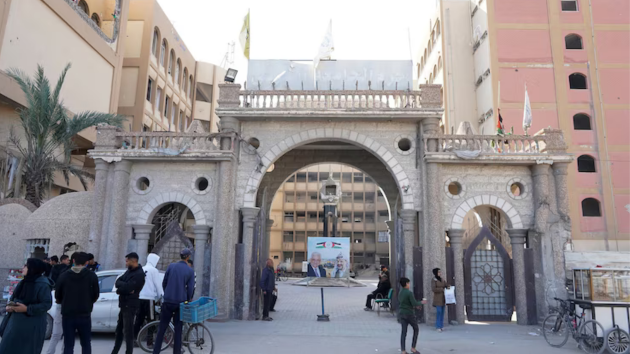
When ABC News visited the temporary campus where Al-Azhar has resumed in-person teaching, the damaged classrooms and improvised facilities reflected the depth of the crisis–yet they also highlighted the resilience of students returning with determination to continue their studies.
The university’s vice president, Dr. Muhammad Shubeir, said the decision to reopen was driven by necessity and by a sense of duty.
“During the difficult period of the war, we resumed the teaching,” online, Shubeir told ABC News. He said the staff worked from dangerous areas just to secure satellite internet. “We faced many risks, but thank God, we were able to continue until the war ended.”
As soon as conditions allowed, the administration said it moved toward restoring in-person learning, even though one of Al-Azhar’s largest campuses–its new facility in the Al Zahra area, which turned into the Netzarim corridor during the war — had been completely leveled.
“Despite losing everything at the university–especially the new campus that housed five colleges–we will begin anew with these buildings, gradually and voluntarily,” he told ABC News in an interview.
Shubeir said the university repeatedly stressed to all parties that it had no role in any conflict, and he recalled a phone call with an Israeli intelligence officer ordering the evacuation of the Zahra campus.
“Al-Azhar University is an academic institution that strives for a culture of peace, coexistence, and respect among all peoples,” Shubeir said. He said he reminded the officer that targeting educational institutions violates the Fourth Geneva Convention, though the warning did not stop the demolition.
The IDF told ABC News it found Hamas terrorist infrastructure in the university that was used for Hamas military activities.
IDF said soldiers on Oct. 30, 2024, identified armed terrorists and an anti-tank missile launching position in the Al-Azhar University area, and guided a fighter jet to strike.
“On Dec. 7, IDF soldiers destroyed enemy infrastructure disguised in buildings, that were used for Hamas’ military activities at Al-Azhar University in the Rimal neighborhood of the Gaza Strip,” IDF said in a statement.
“Terror infrastructures were located in the university campus, among them, an underground terror tunnel that leads from the university yard to a school about a kilometer away from it,” the IDF statement continued. “In addition, many weapons of explosive charges, rocket parts, launchers, explosives activation systems and a variety of technological means were found in the university.”
The financial damage to the school is immense, Shubeir said.
“The new university campus was erased from existence, resulting in a loss of $30 million,” he said. He estimated the total destruction of buildings, equipment, and movable assets at more than $40 million.
Still, he said the university’s message to the world remains unchanged. “In Gaza, there are people who want life. We want to live in peace and stability,” he said.
For some students, returning to campus has been both inspiring and overwhelming. Many have lost homes, academic materials, and years of normal schooling. Mira Al-Agha, a first-year pharmacy student, said her motivation to resume her studies came from her belief that education is the only sustainable path forward.
“Honestly, we have great faith in Al-Azhar University that it will definitely return,” she told ABC News. She said that despite limited facilities, university staff “are still working tirelessly, step by step.”
But she said the emotional toll remains heavy.
“We spent two years in places unsuitable for studying,” she said. “But the spirit of education makes you feel that you want to become something in this world. It gives you the motivation to continue.”
For Mira, transportation is one of the biggest obstacles–traveling from Khan Younis to Gaza City is expensive and unpredictable. She said students need better access to transportation, internet, and study spaces.
For dentistry students at Al-Azhar, the challenges are even greater. Much of their practical training relies on specialized labs and equipment — almost all of which were destroyed, the school said.
Dental student Abdul Rahman Amer, in the 5th level of the dentistry program, said the destruction initially shattered his hope.
“When I saw the building destroyed, I lost hope of ever completing our studies,” he told ABC News. But the university’s effort to secure temporary facilities revived his determination. “This gave us a glimmer of hope to resume our education,” he said.
Amer’s daily routine reflects the broader difficulties facing students. He leaves home before sunrise to catch transportation, which he says can cost around $50 per day.
“These aren’t luxuries,” he said, describing the difficulty of finding dental materials. “We help people and relieve their toothaches. But the tools are difficult to find, and the prices are exorbitant.” Still, he insists he will not give up. “Nothing will benefit me except finishing my studies,” he said.
The reopening of higher-education institutions–however limited–is a reminder that rebuilding Gaza begins with safeguarding its students’ futures, Shubeir said. For thousands of young people walking across damaged campuses each morning, education is not just learning; it is an act of resilience and a statement of survival, he added.
Shubeir said the world should understand that Gaza’s students are holding onto education as their last remaining path to a stable future.
“Our buildings were destroyed, but our will was not,” he said. He urged the international community to support efforts to rebuild academic life in Gaza, stressing that education is the foundation on which recovery must begin. “We want life, peace, and dignity,” he said. “Stand with us so we can protect this generation and give them the future they deserve.”
Copyright © 2025, ABC Audio. All rights reserved.